Scorpions are one of the oldest living predators on Earth, and in Oman, they’re very much a present-day household concern. Whether you’re living in a compound villa in Al Khuwair, a newer apartment in Bausher, or a traditional home near Muttrah, the threat of a scorpion entering your living space is real. Professional scorpion control in Muscat is not a luxury; it’s a practical safety measure every homeowner and tenant needs to understand.
At World FPC, we work with residential and commercial clients across the Muscat Governorate to inspect, treat, and prevent scorpion infestations using methods that are safe for families, pets, and the environment. This guide covers everything you need to know, from identifying the species found locally to choosing the right treatment plan.
Why Scorpion Control in Muscat Matters More Than You Think
Muscat’s warm desert climate, rocky terrain, and seasonal temperature swings create ideal conditions for scorpion activity. These venomous arachnids thrive in sandy soils, under stone walls, inside drainage pipes, and in dense garden mulch. They’re nocturnal hunters, meaning most encounters happen after dark, often in areas you’d never expect.
The concern isn’t just about pain. A sting from a highly venomous species can trigger severe allergic reactions, respiratory distress, and in rare cases, life-threatening envenomation, especially in children, elderly individuals, and people with compromised immune systems. Understanding the local scorpion population is the first step toward effective management.
Scorpion Species Found in Oman: What You’re Actually Dealing With
Not every scorpion carries the same level of risk. Oman is home to several species, and knowing which one you’re facing changes the urgency of your response entirely.
Arabian Fat-Tailed Scorpion (Androctonus crassicauda)
This is the most dangerous scorpion species found in the Middle East and Oman. It’s dark brown to black, grows up to 10 centimetres in length, and carries a highly potent neurotoxic venom. It’s commonly found along Muscat’s rocky outskirts, construction zones, and areas near the Hajar Mountains. A sting from this species requires immediate medical attention.
Yellow Scorpion (Leiurus quinquestriatus)
This species is smaller, pale yellow in colour, and is also considered medically significant. It’s sometimes found near sandy soils and residential gardens in suburban Muscat areas. Despite its smaller size, its venom is potent and should never be dismissed.
Lesser-Known Desert Scorpions
Several other scorpion species inhabit Oman’s landscape, including members of the Scorpionidae and Diplocentridae families. While many are less venomous, they still sting defensively when disturbed. Their presence in your home always warrants a professional inspection.
| Species | Colour | Size | Venom Level | Common Habitat |
|---|---|---|---|---|
| Arabian Fat-Tailed (Androctonus crassicauda) | Dark brown to black | Up to 10 cm | High (neurotoxic) | Rocky terrain, construction zones |
| Yellow Scorpion (Leiurus quinquestriatus) | Pale yellow | 5–8 cm | High | Sandy soils, garden borders |
| Desert Scorpion (Scorpionidae spp.) | Light brown | 4–7 cm | Moderate | Under stones, dry walls |
| Black Rock Scorpion (Nebo hierichonticus) | Black | 8–12 cm | Low to moderate | Rocky crevices, hillsides |
Where Scorpions Hide in Your Home in Muscat
Scorpions are expert hiders. They’re attracted to dark, damp, and undisturbed spaces where they can shelter from Oman’s intense daytime heat. Knowing their favourite hiding spots helps you act before an encounter happens.
Indoor Hiding Areas
Inside your home, scorpions frequently shelter inside footwear left near entrances, folded laundry or towels, behind loose skirting boards, and under heavy furniture such as wardrobes and sofas. They also enter through gaps around pipe joints under sinks and behind washing machine connections.
Outdoor Risk Zones
Outside, they nest under rocks, in garden compost piles, inside storage boxes left on patios, along the base of compound walls, and in any rubble left from construction activity. In older Muscat neighbourhoods, poorly maintained drainage channels near homes are also common scorpion corridors.
Signs You May Have a Scorpion Problem at Home
Most homeowners don’t spot a scorpion until a sting has already occurred. But there are earlier warning indicators that suggest these pests have settled in or near your property.
You’re likely dealing with a scorpion presence if you notice other insect populations such as crickets, cockroaches, and beetles increasing around your home, since these are primary food sources for scorpions. Spotting shed exoskeletons near cracks or wall corners is another strong indicator. And of course, any direct visual sighting at night, even a single scorpion, warrants a professional assessment.
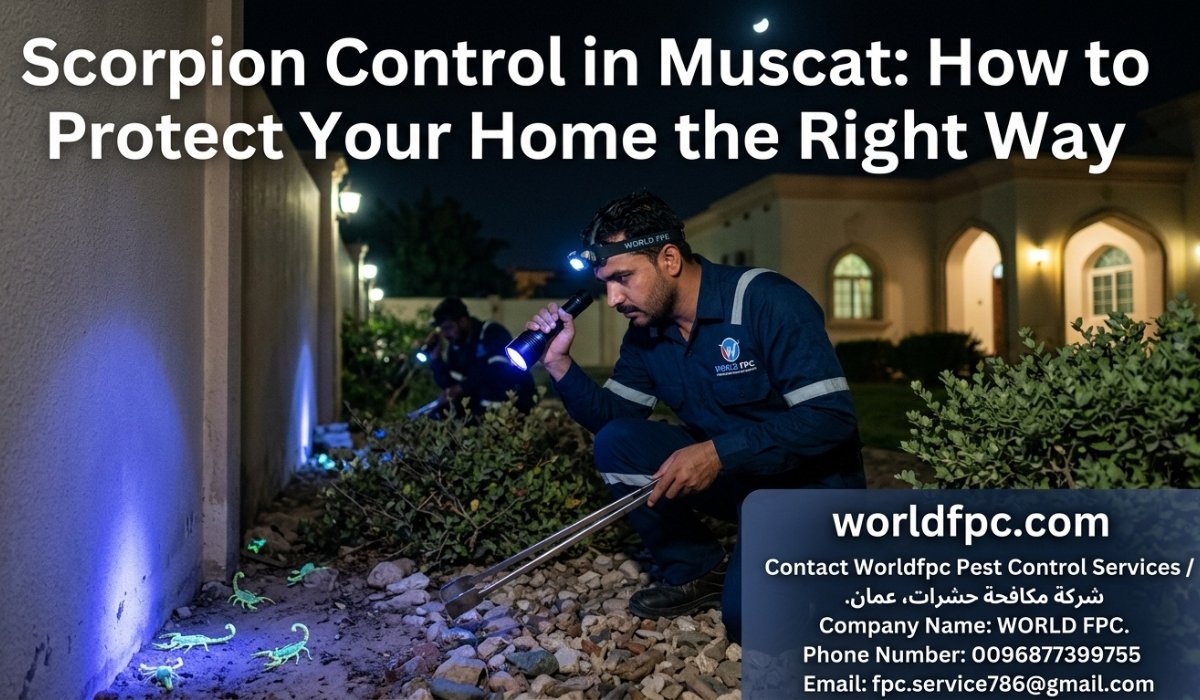
A UV blacklight torch is one of the most effective DIY detection tools available. Scorpions fluoresce a bright blue-green colour under ultraviolet light, making nighttime inspections surprisingly reliable. This method is widely used by professional pest technicians during initial site surveys.
What Happens When a Scorpion Stings: Symptoms and First Aid
Understanding what a sting actually does to the body helps you respond correctly under pressure, especially when children are involved.
Common Sting Symptoms
Most scorpion stings cause immediate sharp pain at the sting site, followed by localised swelling, redness, and a burning or tingling sensation. Mild stings from less venomous species may resolve within a few hours with basic care.
Severe Symptoms Requiring Emergency Care
Stings from highly venomous species like Androctonus crassicauda can trigger muscle spasms, difficulty breathing, excessive sweating, rapid heart rate, drooling, blurred vision, and full-body numbness. These are medical emergencies. Do not wait to see how symptoms progress.
First Aid Steps After a Scorpion Sting
First, move the affected person away from the area and remain calm. Wash the sting site with soap and clean water. Apply a cool compress to reduce swelling. Do not attempt to suck out venom or apply a tourniquet. Seek immediate medical attention at the nearest hospital. In Muscat, the Sultan Qaboos University Hospital and Royal Hospital are equipped to manage envenomation cases. Keep the person still and monitor their breathing closely while en route.
| Symptom Type | Response | Urgency |
|---|---|---|
| Pain, swelling, redness at sting site | Cool compress, soap and water wash | Monitor at home if mild |
| Numbness spreading from sting site | Seek medical attention | Urgent |
| Muscle spasms, difficulty breathing | Emergency hospital visit | Immediate |
| Child or elderly person stung | Emergency hospital visit regardless of severity | Immediate |
| Stung by unknown or large species | Emergency hospital visit | Immediate |
Scorpion Prevention: Practical Steps Every Muscat Homeowner Should Take
Prevention is genuinely more effective and less disruptive than reactive treatment. These measures are practical, low-cost, and proven within Oman’s residential environment.
Seal Entry Points Thoroughly
Scorpions can squeeze through gaps as narrow as a credit card’s width. Inspect all door frames, window seals, pipe penetrations through walls, and the junction between wall and floor. Use silicone sealant or weatherstripping to close any gaps you find. Pay special attention to utility rooms, kitchens, and bathrooms, where pipe entry points are most common.
Reduce Clutter and Outdoor Debris
Remove stacked firewood, old cardboard boxes, piles of stones, and unused garden equipment from around your home’s perimeter. These materials are prime scorpion shelters. In Oman’s heat, clearing these zones reduces not just scorpion risk but general pest activity significantly.
Manage Your Garden and Irrigation
Overwatered gardens attract the insects that scorpions hunt. Adjust irrigation schedules to avoid pooling or excessive moisture near walls and foundations. Trim back low-growing plants that touch the building structure, as these create sheltered access routes for scorpions moving from the garden into the home.
Use Yellow or Sodium Light Outdoors
White and UV outdoor lights attract insects at night, which in turn attract scorpions. Switching to sodium vapour or yellow-tinted bulbs around entrances and gardens reduces the insect activity that draws scorpions close to your home.
Shake Out Before Wearing or Using
This simple habit prevents most indoor sting incidents. Shake out shoes, boots, gloves, and clothing that’s been stored or left on the floor before putting them on. This applies especially to items stored in garages, utility rooms, and garden storage areas.
Professional Scorpion Control in Muscat: What the Process Looks Like
DIY sprays and over-the-counter pesticides rarely solve a scorpion problem permanently. Scorpions are resistant to many common insecticides, and without addressing entry points and harborage zones, new scorpions simply replace the ones that are removed. Professional pest management takes a structured, multi-stage approach.
Stage 1: Site Survey and Infestation Assessment
A trained technician from World FPC inspects the property using UV detection torches, moisture meters, and a systematic room-by-room walkthrough. The survey identifies active harborage zones, entry points, conducive conditions, and the species present. This stage determines the treatment intensity required.
Stage 2: Targeted Residual Pesticide Application
Professional-grade residual insecticides approved by Oman’s Ministry of Environment are applied to the perimeter, baseboards, entry points, garden borders, and known hiding zones. These products have a sustained effect that remains active for several weeks, killing scorpions that pass over treated surfaces.
Stage 3: Physical Exclusion and Habitat Modification
Alongside chemical treatment, technicians recommend and, where contracted, carry out physical exclusion measures. This includes sealing wall gaps, fitting door sweeps, and advising on landscape modifications that reduce harborage near the building structure.
Stage 4: Follow-Up Inspection and Preventive Maintenance
A single treatment is rarely sufficient for high-activity properties. World FPC offers scheduled follow-up visits and annual maintenance contracts that keep your home protected throughout the year, including during peak summer activity months when scorpions are most mobile.
Scorpion Control for Villas, Compounds, and Commercial Properties
The approach to scorpion management differs significantly depending on the property type. A family villa requires different protection strategies than a school campus or a hotel compound.
Residential Villas and Apartments
For private homes, the focus is on full perimeter treatment, interior spot applications in high-risk zones, and monthly or quarterly maintenance contracts. Families with young children or pets benefit most from gel-based or low-odour treatment options that pose minimal indoor exposure risk.
Compounds and Gated Communities
Large compounds require coordinated treatment across shared garden spaces, boundary walls, utility corridors, and common areas. World FPC works with compound management teams to schedule minimally disruptive treatments that cover the entire community simultaneously.
Commercial and Industrial Properties
Warehouses, construction sites, and industrial facilities in areas such as Rusayl and Sohar Industrial Estate carry elevated scorpion risk due to ground disturbance, material storage, and proximity to desert habitat. Regular inspections and perimeter barrier treatments are standard for these environments.
Comparing DIY Scorpion Control vs. Professional Treatment
| Factor | DIY Methods | World FPC Professional Treatment |
|---|---|---|
| Species identification | Often inaccurate | Accurate, species-specific approach |
| Product effectiveness | General-purpose, low residual activity | Professional-grade, long residual period |
| Entry point sealing | Rarely addressed | Included in comprehensive treatment |
| Safety for children and pets | Risk of misapplication | Municipality-approved, guided application |
| Long-term results | Temporary relief only | Sustained protection with follow-up visits |
| Documentation | None | Written treatment report provided |
Seasonal Scorpion Activity in Oman: When to Act
Scorpion activity in Muscat follows a predictable seasonal pattern tied closely to temperature. Understanding this cycle helps homeowners time their treatments for maximum effectiveness.
Activity increases significantly from April through October when temperatures consistently exceed 35°C. Scorpions become more mobile during these months, actively searching for cooler, moisture-rich environments, which is exactly when indoor intrusions peak. The cooler months from November to March see reduced activity, but scorpions don’t disappear. They shelter in deeper crevices and emerge on warm days.
The most effective treatment window is late March to early April, just before peak activity begins. Applying residual barrier treatments at this point gives protection throughout the highest-risk months. A secondary application in October helps manage late-season movement as scorpions search for winter shelter.
Frequently Asked Questions About Scorpion Control in Muscat
Are scorpions common inside homes in Muscat?
How long does a professional scorpion treatment last?
Is professional pest treatment safe for children and pets?
What should I do if I find a scorpion inside my home?
Does World FPC offer emergency scorpion removal in Muscat?
Can I prevent scorpions from entering without chemicals?
Which areas of Muscat have the highest scorpion risk?
Choose World FPC for Scorpion Control in Muscat
Protecting your home from scorpions in Oman requires more than a single spray treatment. It demands a complete understanding of local species behaviour, a systematic inspection process, professionally applied residual barriers, and a follow-up plan that keeps pace with seasonal activity. That’s what World FPC brings to every property we service.
We’re experienced in residential villas, compound communities, commercial facilities, and industrial sites across Muscat and the wider Sultanate. Every treatment is backed by a written report, documented follow-up, and our commitment to using only approved, environmentally responsible pest management solutions.
Your family’s safety is worth a professional response. Contact World FPC today to schedule a scorpion risk assessment and take the first step toward a genuinely protected home in Muscat.