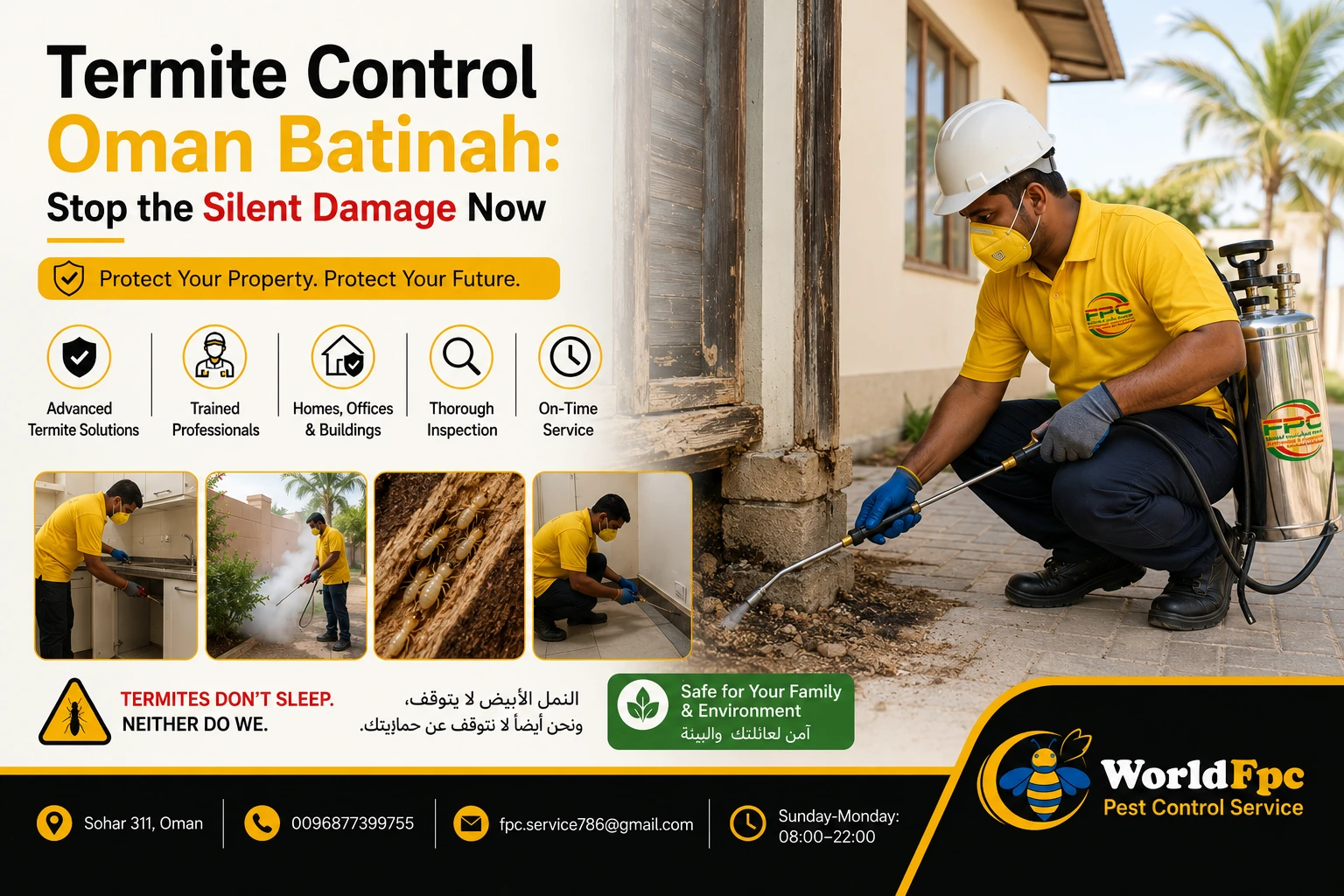
Why Termite Control in Oman’s Batinah Region Demands Serious Attention
Al Batinah is one of Oman’s most populated and agriculturally active governorates. The coastal humidity, warm temperatures year-round, and heavy construction activity across Sohar, Barka, Rustaq, Nakhal, and Shinas create the exact conditions that termites thrive in. Without professional termite control in Oman Batinah, a colony can silently consume structural timber, furniture, and flooring for months before the damage becomes visible.
World FPC has been addressing termite infestations across Oman with certified methods and locally experienced technicians. This guide explains what you’re dealing with, how treatment works, and why early action is the smartest financial decision you can make.
What Types of Termites Are Active in Al Batinah?
Subterranean Termites (Anacanthotermes ochraceus)
This is the most destructive species across the Arabian Peninsula, including Oman. Subterranean termites nest underground and travel to wood through earthen mud tubes. They’re responsible for the majority of structural damage in residential and commercial buildings in the Batinah region. A single mature colony contains hundreds of thousands of workers.
Drywood Termites (Cryptotermes spp.)
Drywood termites nest directly inside dry wood without needing soil contact. They’re commonly found in roof timbers, wooden furniture, window frames, and imported lumber. In Al Batinah’s dry inland areas like Rustaq and Awabi, drywood termite activity is particularly common in older villas and date palm farms.
Sand Termites (Psammotermes hypostoma)
Sand termites are uniquely adapted to Oman’s arid sandy soils. They’re often found attacking tree roots, agricultural land, and the foundations of low-rise buildings in coastal and semi-arid zones. World FPC technicians are trained to identify and treat this species, which many pest companies in Oman overlook entirely.
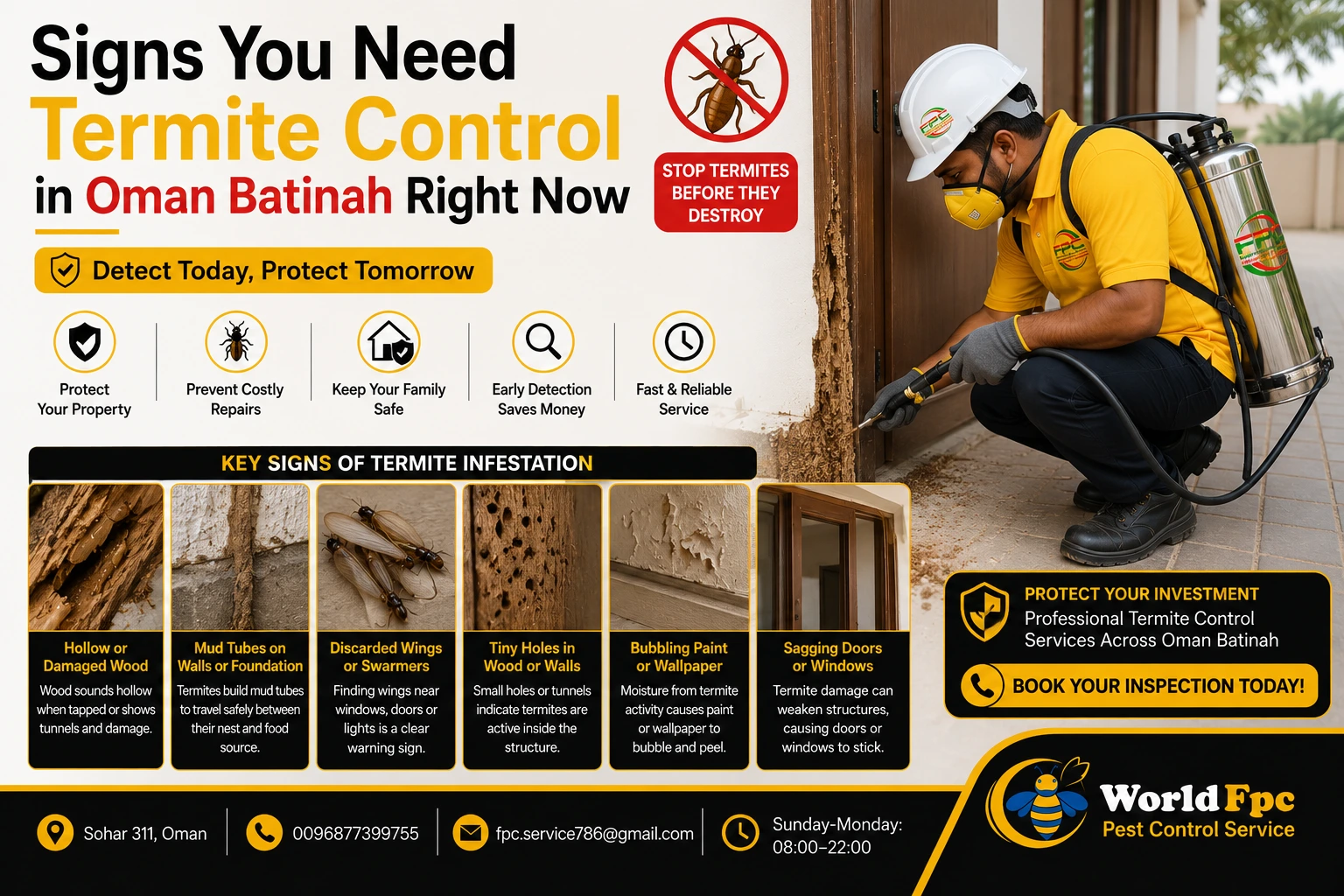
Signs You Need Termite Control in Oman Batinah Right Now
Mud Tubes on Walls or Foundations
Subterranean termites construct thin mud tubes the width of a pencil along walls, pipes, and foundation edges. These tubes protect them from air and predators. Spotting mud tubes on your property is a reliable indicator that a colony is actively feeding inside your building’s structure.
Hollow-Sounding Wood
Tap your door frames, skirting boards, window frames, or wooden beams with a knuckle. A hollow or papery sound means termites have eaten the interior while leaving only a thin surface shell. This is one of the most common signs homeowners in Sohar and Barka report before calling World FPC.
Discarded Wings Near Windows or Doors
Swarmers are reproductive termites that fly out in large numbers during warm, humid evenings, particularly after spring and autumn rains across Al Batinah. They shed their wings immediately after landing. Finding piles of small translucent wings near light sources, windowsills, or doorways signals a mature colony nearby.
Frass or Termite Droppings
Drywood termites push their droppings, known as frass, out of small kick-out holes in infested wood. These pellets are tiny, six-sided, and sand-colored. Finding frass below furniture joints, wooden cabinets, or along skirting boards is a classic sign of active drywood termite infestation.
Tight-Fitting Doors and Windows
As termites consume and damage wood, moisture from their activity causes wooden frames to warp slightly. Doors and windows that suddenly feel stiff or misaligned, especially in ground-floor rooms, should be inspected immediately by a licensed technician.
World FPC Termite Treatment Methods for Al Batinah Properties
Pre-Construction Anti-Termite Soil Treatment
The most cost-effective termite protection is applied before construction begins. World FPC treats the soil beneath and around the foundation with a Ministry-approved liquid termiticide barrier. This creates a chemical zone that termites cannot cross. Pre-construction treatment is mandatory under many Oman municipality guidelines and comes with a structural warranty.
For example, a new villa being built in Sohar Industrial Area would receive soil treatment at each construction stage: during excavation, before slab pouring, and after external walls are completed. This three-stage approach ensures full barrier coverage.
Post-Construction Termite Control Treatment
For existing buildings with active infestations, World FPC uses a combination of methods based on the termite species identified and the severity of the infestation.
- Soil injection and barrier treatment: Holes are drilled at intervals of 30 cm along internal wall-floor junctions. A water-based termiticide emulsion is injected under pressure to create a soil barrier beneath the structure. This method targets subterranean termites.
- Wood injection treatment: For door frames, window frames, and wooden fixtures, 12 mm holes are drilled and termiticide emulsion is injected directly into the wood to eliminate drywood termites inside the timber.
- Localized spot treatment: For smaller, contained infestations in furniture or isolated timber sections, our technicians apply targeted chemical treatment without disturbing the wider structure.
Termite Bait Station Systems
Bait stations are an advanced, low-disruption solution well-suited for villas, hotels, and agricultural properties in Al Batinah. Stations are installed in the soil around the perimeter of the building at regular intervals. Workers carry slow-acting bait back to the colony, eventually eliminating the entire nest including the queen.
World FPC installs and monitors bait station systems on a scheduled basis, making them ideal for long-term termite management on larger properties in Rustaq, Nakhal, and Shinas.
Fumigation for Severe Drywood Infestations
In cases where drywood termites have spread extensively through roof timbers, wooden ceilings, or large furniture sets, whole-space fumigation may be the most effective solution. World FPC coordinates fumigation services with proper site preparation, safety protocols, and post-treatment verification.
Termite Control Oman Batinah: Treatment Comparison Table
| Treatment Method | Best For | Coverage | Duration | Warranty |
|---|---|---|---|---|
| Pre-Construction Soil Barrier | New buildings | Full foundation | Permanent | Up to 10 years |
| Post-Construction Soil Injection | Existing villas and buildings | Internal perimeter | 3 to 5 years | Yes |
| Wood Injection Treatment | Door/window frames, fixtures | Targeted areas | 2 to 3 years | Yes |
| Bait Station System | Large properties, hotels, farms | Full perimeter | Ongoing monitoring | Yes |
| Localized Spot Treatment | Furniture, isolated timber | Specific zone | 1 to 2 years | Case by case |
| Fumigation | Severe drywood infestations | Whole structure | One-time | Inspection-based |
Areas World FPC Serves Across Al Batinah
Al Batinah North: Sohar, Shinas, Liwa, Saham, Al Khaburah, Suwaiq Al Batinah South: Barka, Musanah, Nakhal, Rustaq, Awabi, Al Wusta areas adjacent to Batinah
Whether it’s a residential villa in Barka, a commercial warehouse in Sohar Free Zone, or a date palm farm in Nakhal, World FPC technicians respond with the right treatment method for each environment.
Why Al Batinah Properties Face Elevated Termite Risk
Al Batinah’s geography creates a high-risk termite environment in multiple ways. The coastline means consistent humidity levels that subterranean termites need to survive and expand colonies. Agricultural land throughout the governorate contains the organic-rich soil these insects favor for nesting. Rapid construction across Sohar and Barka has disturbed existing termite colonies, pushing them into adjacent residential zones.
Date palm farming, traditional in Nakhal and Rustaq, is especially vulnerable. Termites attack palm root systems and can destroy mature trees that took years to cultivate. World FPC provides agricultural termite treatment programs specifically tailored to Oman’s farming communities.
The Cost of Ignoring Termite Infestation
Many property owners in Oman delay treatment because termite damage isn’t immediately visible. This is the most expensive mistake you can make. A subterranean termite colony can consume one kilogram of wood per day at full colony strength. Over a single year, that translates to structural beams, flooring, furniture, and cabinetry that cannot be repaired and must be replaced entirely.
Insurance policies in Oman typically do not cover termite damage, as it is classified as a preventable pest issue. The cost of World FPC’s professional treatment is a fraction of what structural repair or furniture replacement costs after a full infestation.
Integrated Pest Management Approach to Termite Control
World FPC follows an IPM framework rather than relying on chemical treatments alone. IPM combines inspection, identification, targeted treatment, and long-term prevention to deliver results that last.
Inspection phase: A certified technician assesses the property, identifies the termite species, maps the affected zones, and evaluates the risk to the structure.
Treatment phase: The appropriate treatment method is selected based on the inspection findings. This could be soil injection, bait stations, wood treatment, or a combination of methods.
Prevention phase: After treatment, World FPC provides clients with a prevention checklist covering moisture management, wood-to-soil contact reduction, storage practices, and periodic inspection scheduling.
Frequently Asked Questions About Termite Control in Al Batinah, Oman
How do I know whether I have termites or ants?
Termites have straight antennae, a wide waist with no narrowing between the thorax and abdomen, and equal-length wings. Flying ants have bent antennae, a clearly pinched waist, and unequal wings. If you’re unsure, World FPC offers a no-obligation inspection to correctly identify the pest.
Is anti-termite treatment safe for children and pets?
Yes. World FPC uses water-based termiticide formulations that are low in volatility once applied and dry. Technicians advise clients on the appropriate re-entry period for each treatment type, which is typically two to four hours. Treatment areas are ventilated before and after the process.
How long does a termite treatment last in Al Batinah?
Post-construction soil barrier treatments typically last three to five years in Oman’s climate. Pre-construction treatments with a full warranty can last up to ten years. Bait station programs provide continuous protection as long as monitoring is maintained. World FPC schedules follow-up inspections to verify treatment integrity.
Does World FPC treat agricultural land and date palm farms?
Yes. World FPC provides agricultural termite control for date palm farms, crop fields, and farmhouses across Nakhal, Rustaq, and the wider Al Batinah interior. Sand termite and subterranean termite treatments for agricultural land use formulations approved for use near food-producing plants.
What is the difference between pre-construction and post-construction termite treatment?
Pre-construction treatment is applied to the soil before a building’s foundation is poured. It’s more effective, more affordable, and longer-lasting. Post-construction treatment is applied to an existing building, typically through drilling, injection, or bait stations, and is used when pre-construction treatment was not applied or when an active infestation is discovered.
Can termites come back after treatment?
Without ongoing monitoring, termite reinfestation is possible, particularly in high-risk areas near agriculture or with significant soil disturbance. World FPC recommends annual inspection and, for larger properties, a maintained bait station program to prevent recolonization.
Does World FPC cover all areas in Batinah?
World FPC serves the full extent of Al Batinah North and South, including Sohar, Shinas, Barka, Rustaq, Nakhal, Saham, Suwaiq, Liwa, Musanah, and Awabi. Contact us to confirm scheduling and response time for your specific location.
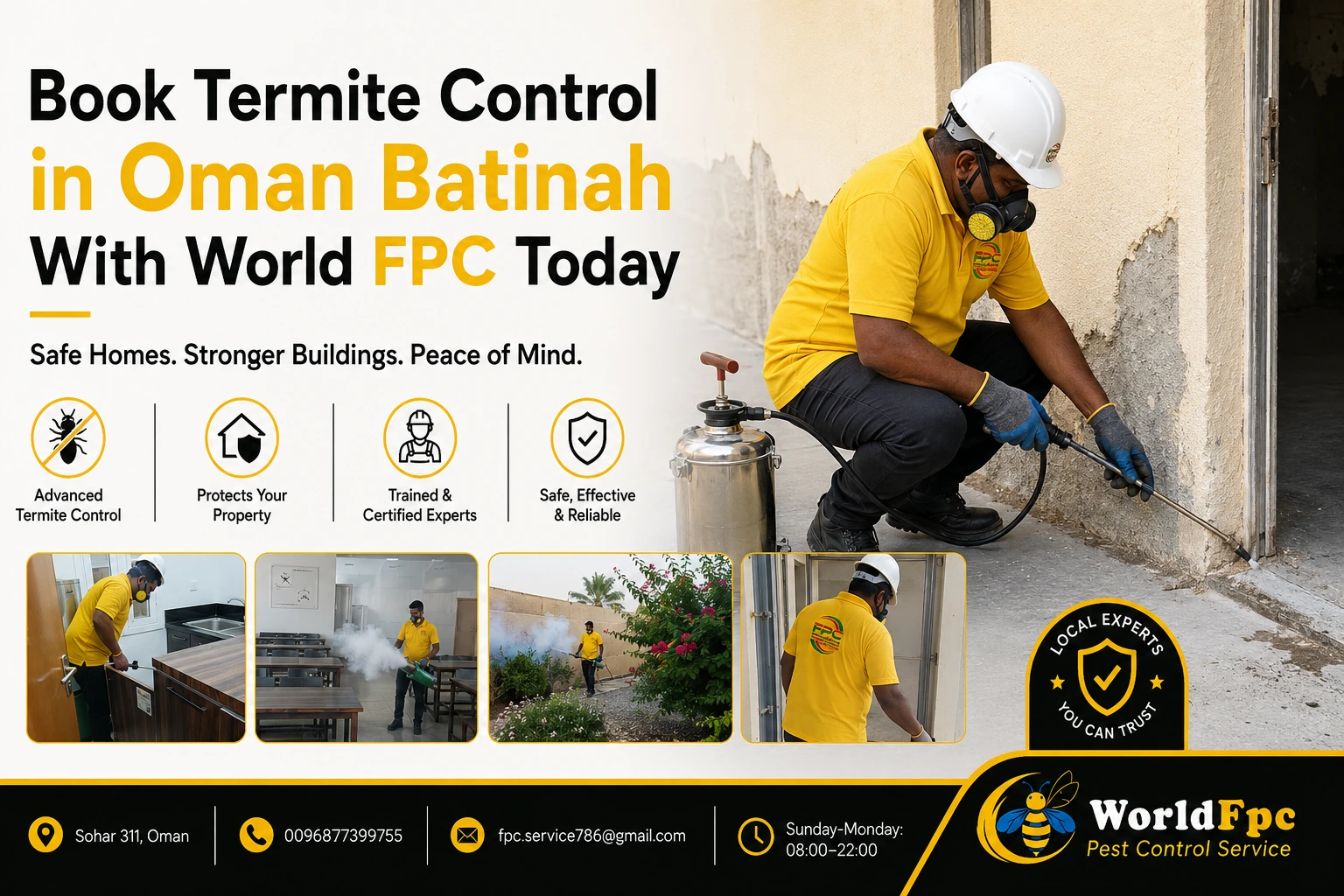
Book Termite Control in Oman Batinah With World FPC Today
Termites do not stop on their own. Every day without treatment is another day of invisible, compounding damage to your property. World FPC’s certified team is ready to inspect your home, villa, commercial space, or agricultural land anywhere across Al Batinah and deliver a tailored treatment plan.
Contact World FPC for a professional termite inspection and to schedule the right treatment for your property. Our team responds promptly, works with minimal disruption to your daily routine, and stands behind every treatment with written documentation and warranty coverage where applicable.